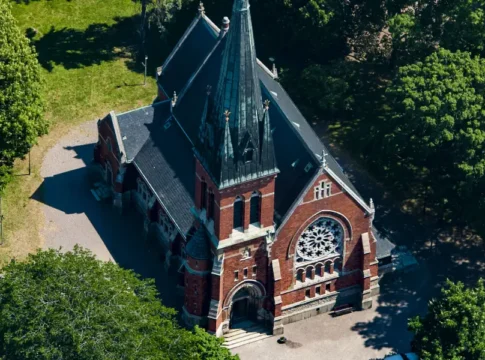
St. Johannes Church is a Gothic Revival church in Norrmalm, designed by architect Carl Möller and completed in the late 19th century. Its elevated position on Brunkebergsåsen and its architecture make it a prominent landmark in central Stockholm.
St. Johannes Church: Gothic Revival Vision on Brunkebergsåsen
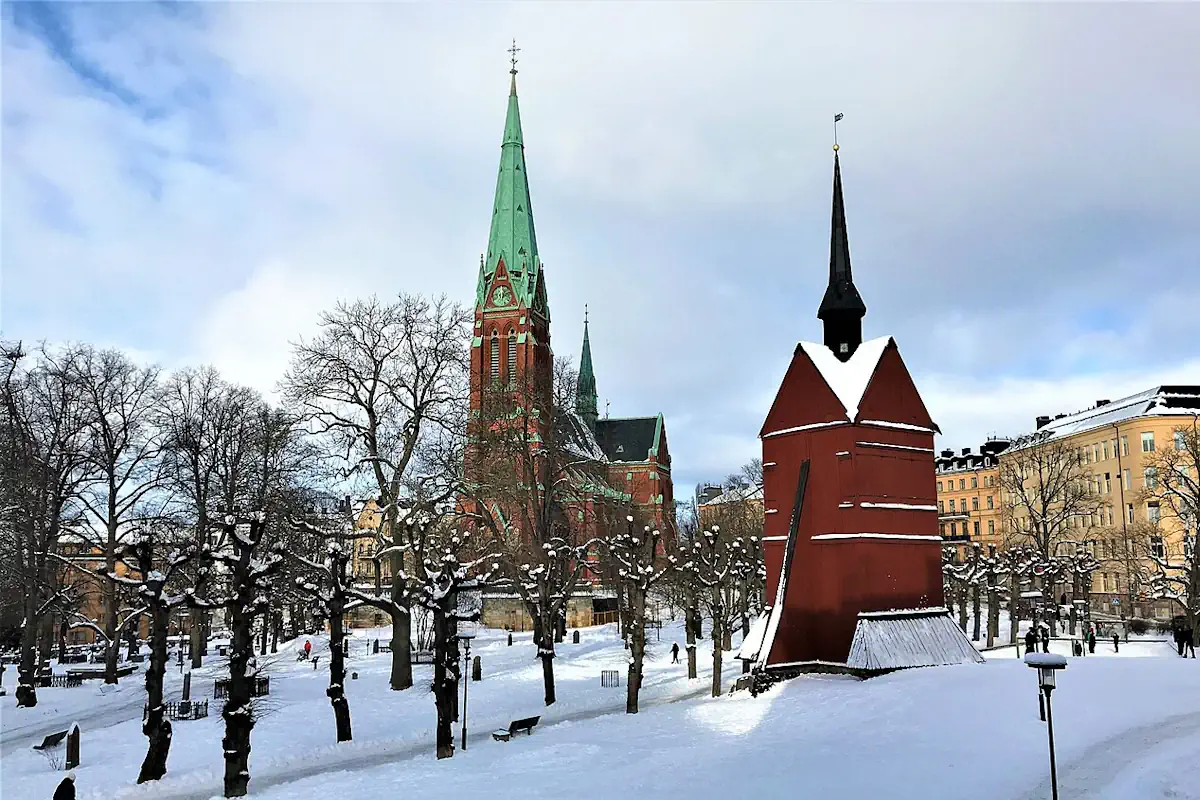
St. Johannes Church (S:t Johannes kyrka) rises above central Stockholm on Brunkebergsåsen, its red-brick spire visible across Norrmalm. Completed in 1890, it reflects a period when Stockholm was transforming into a modern capital — and when architecture was used to reconnect the city with its imagined medieval past.
Set within a quiet park just steps from busy streets, the church combines dramatic Gothic Revival design with a sense of urban retreat, offering both historical depth and everyday stillness in the heart of the city.
- Completed: 1890
- Style: Gothic Revival (Neo-Gothic)
- Architect: Carl Möller
- Location: Norrmalm, atop Brunkebergsåsen
- Height: Tower reaching approx. 70 meters
- Role: Parish church and cultural venue

A Long Path to Construction
The history of St. Johannes Church stretches back to 1651, when a wooden chapel first stood on this elevated site. Over the following centuries, several attempts were made to replace it with a permanent stone church, reflecting the growing importance of the surrounding district.
In the 18th century, King Gustav III initiated plans for a grand new church, but the project never materialized. It was not until the late 19th century — during a period of rapid urban expansion — that construction finally began.
In 1883, architect Carl Möller won the design competition with a bold Neo-Gothic proposal. Construction started exactly 100 years after Gustav III’s initiative, and in 1890 the church was consecrated in the presence of King Oscar II.
The long delay between vision and realization reflects Stockholm’s transformation from a modest capital into a modern European city.
Architecture and Gothic Revival Identity
St. Johannes Church is one of Stockholm’s most striking examples of Gothic Revival architecture — a style that looked back to the Middle Ages while expressing 19th-century ambitions.
Its defining features include:
- ⛪ Soaring tower: Rising approximately 70 meters, visible across central Stockholm
- 🔔 Bell ensemble: Five bells, including Sweden’s largest steel bell
- 🎨 Painted vaults and stained glass: Creating a richly colored interior atmosphere
- 🏛️ Red-brick construction: Emphasizing verticality and historic character
Unlike medieval churches such as Storkyrkan, which evolved organically over centuries, St. Johannes was designed as a complete artistic vision — a deliberate reinterpretation of Gothic form in a modern city.


A Church Above the City
Perched on Brunkebergsåsen, St. Johannes Church occupies one of the highest natural points in central Stockholm. This elevated position gives it a commanding presence while also creating a sense of separation from the surrounding city.
Below, the streets of Norrmalm reflect Stockholm’s modern urban life. Above, the churchyard offers quiet paths, trees, and open space — a contrast that defines the experience of visiting St. Johannes.
This relationship between elevation and atmosphere makes the church not just a landmark, but a place of transition between movement and stillness.
A Changing Religious Landscape
In the 21st century, St. Johannes Church has entered a new chapter. After serving as a parish church within the Church of Sweden, it is transitioning to the Catholic Diocese of Stockholm — reflecting the city’s evolving religious and cultural composition.
Already hosting Polish and Ukrainian congregations, the church is becoming a center for diverse communities while preserving its architectural and historical identity. The surrounding churchyard, however, will remain under the care of the Church of Sweden — maintaining a link to the site’s earlier parish history.
Visiting St. Johannes Church
St. Johannes Church is located in Norrmalm, within walking distance of Sveavägen and easily accessible via Rådmansgatan metro station. Its park setting makes it an ideal stop for visitors seeking a quieter experience in central Stockholm.
Nearby, you can explore other churches such as Klara Church and Adolf Fredrik Church, each reflecting different phases of the city’s architectural and historical development.
⛪ Related Churches in Stockholm
- 🌆 Klara Church – A Gothic Revival skyline landmark in central Stockholm.
- 🎼 Adolf Fredrik Church – An 18th-century church known for its cultural legacy.
- 🕍 German Church – A Baroque landmark shaped by Stockholm’s Hanseatic past.
- 👑 Storkyrkan – Stockholm’s medieval cathedral and coronation church.
Why St. Johannes Church Matters
St. Johannes Church represents a moment when Stockholm looked both forward and backward — embracing modern urban growth while drawing inspiration from its medieval heritage.
Through its architecture, location, and evolving role, it captures the layered identity of the Swedish capital: a city shaped by history, yet constantly redefining itself.

 In partnership with Agoda