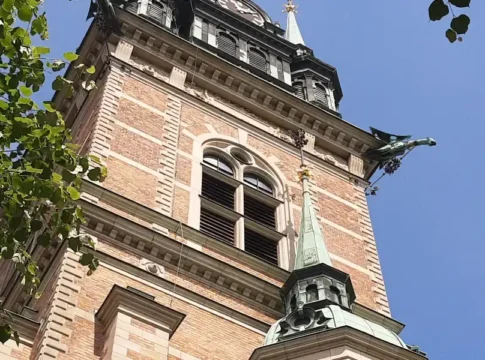
Storkyrkan (Stockholm Cathedral) is Sweden’s royal cathedral and the oldest surviving church in the capital. Founded in the 13th century, it has served as the site of coronations, royal weddings, and national ceremonies, and remains a central monument in Gamla Stan.
Storkyrkan – Sacred Power at the Heart of Medieval Stockholm
In medieval Stockholm, political authority and spiritual legitimacy stood side by side. Rising beside the medieval fortress of Tre Kronor, Storkyrkan — the Church of Saint Nicholas — became the ecclesiastical heart of the emerging capital. Founded in the 13th century, during Stockholm’s formative decades, the cathedral functioned not merely as a place of worship, but as the sacred stage upon which Sweden’s monarchy asserted its authority.
For centuries, kings were crowned here, victories were sanctified here, and national crises unfolded in its shadow. As Stockholm grew from fortified outpost to political center, Storkyrkan anchored the city’s spiritual and institutional life — binding crown, church, and capital into a single axis of power.
- Founded: 13th century
- Denomination: Lutheran (Church of Sweden)
- Location: Gamla Stan, beside the Royal Palace
- Also known as: Stockholm Cathedral, Church of Saint Nicholas
- Function: Sweden’s royal cathedral and coronation church
- Notable feature: Site of coronations and royal weddings
- Architectural style: Gothic structure with Baroque interiors
Storkyrkan formed part of a broader sacred landscape in medieval Stockholm. Nearby, Riddarholmen Church developed into Sweden’s royal burial church, while the German Church reflected the growing influence of the Hanseatic merchant community. Together, these churches reveal how faith, trade, and monarchy shaped the capital’s identity.


Church and Crown in Medieval Stockholm
When Birger Jarl consolidated Stockholm in the mid-13th century, the establishment of a central church was as politically significant as the construction of fortifications. Medieval rulership required spiritual sanction. A capital without a cathedral lacked sacred legitimacy.
Situated beside the royal castle, Storkyrkan formed part of a deliberate urban arrangement: fortress and church, sword and altar. From this proximity emerged a powerful symbolic message — royal authority governed the realm, but divine order sanctified it.
Coronations, royal proclamations, and state ceremonies reinforced this union. Within these vaulted walls, kings were not only elevated politically but affirmed spiritually. The cathedral thus became an institutional partner in the consolidation of Swedish monarchy.
The Coronation of 1520 and the Shadow of the Bloodbath
On November 4, 1520, Christian II of Denmark was crowned King of Sweden inside Storkyrkan. The ceremony projected reconciliation after years of conflict within the Kalmar Union. Yet within days, that promise collapsed.
Just beyond the cathedral walls, in nearby Stortorget, mass executions were carried out in what became known as the Stockholm Bloodbath. The contrast was stark: sacred coronation followed by political purge. The cathedral had witnessed the sanctification of royal authority — only to see that authority descend into violence.
This episode cemented Storkyrkan’s place not only in religious history but in the political rupture that reshaped Sweden’s destiny.
The Reformation: From Catholic Cathedral to Lutheran State Church
In the decades following the Bloodbath, Gustav Vasa initiated the Swedish Reformation. Storkyrkan once again stood at the center of transformation. Reformers such as Olaus Petri preached Lutheran doctrine here, challenging papal authority and aligning the church with the emerging Protestant monarchy. In 1531, Olaus Petri was appointed the first Lutheran archbishop of Uppsala, formalizing Sweden’s break with Rome.
Church wealth was redirected to the crown, and ecclesiastical independence diminished. The cathedral that had once embodied medieval Catholic order became an instrument of royal consolidation. Through the Reformation, sacred authority was not abolished — it was absorbed into the state.
This transformation mirrored Sweden’s broader shift from medieval fragmentation to centralized monarchy. Within Storkyrkan’s walls, theology and governance converged.


Architecture as Political Symbol
Storkyrkan’s architecture reflects this layered history. Its Gothic foundations, with ribbed vaults and brick construction, speak to the medieval expansion of Stockholm. The later Baroque high altar and ornate pulpit signal the aesthetic and ideological shifts of the early modern period.
Rather than representing a single era, the cathedral embodies institutional continuity — a structure reshaped across centuries as Sweden’s monarchy, theology, and statecraft evolved together.
St. George and the Dragon: Faith and Victory
Among Storkyrkan’s most celebrated treasures is the late 15th-century wooden sculpture of St. George and the Dragon, created by Bernt Notke in 1489.
Commissioned by Regent Sten Sture the Elder to commemorate his victory over Danish forces at the Battle of Brunkeberg (1471), the sculpture operates on multiple levels. It depicts a Christian saint defeating evil, yet it also symbolized Swedish resistance within the Kalmar Union.
Placed within the cathedral, the work transformed military triumph into sacred narrative. Political victory was framed as divine favor — reinforcing the fusion of crown and church that defined medieval Stockholm.
Royal Ceremonies and National Continuity
Across centuries, Storkyrkan has hosted coronations, royal weddings, baptisms, and funerals. From medieval monarchs to modern royalty, the cathedral remains Sweden’s royal church.
The 1976 wedding of King Carl XVI Gustaf and Queen Silvia, and the 2010 wedding of Crown Princess Victoria and Prince Daniel, reaffirmed the cathedral’s enduring ceremonial role. Though the Swedish monarchy today is constitutional, the symbolic continuity of place remains powerful.
Storkyrkan thus bridges eras — from medieval kingship to contemporary statehood — maintaining a ceremonial thread that stretches across nearly eight centuries.
⛪ Related Churches in Stockholm
- 👑 Riddarholmen Church (Royal Burial Church) – Sweden’s royal burial church and dynastic mausoleum.
- 🕍 German Church in Gamla Stan – The Hanseatic merchants’ church in Gamla Stan.
- 🌊 Katarina Church – A prominent Södermalm landmark rebuilt after devastating fires.
- 🌿 Hedvig Eleonora Church – An elegant 17th-century church in Östermalm.
A Living Chronicle of the Capital
Located in Gamla Stan, directly beside the Royal Palace and steps from Stortorget, Storkyrkan remains embedded in the urban fabric first shaped during the Middle Ages. Its walls have witnessed coronations and conflict, reform and reconciliation.
If Birger Jarl laid Stockholm’s political foundations, and Gustav Vasa consolidated royal authority, Storkyrkan provided the sacred legitimacy that bound these transformations together. It stands not only as Stockholm’s oldest church, but as a living chronicle of Swedish state formation.
🧭 Continue Exploring Medieval Stockholm
- 👑 Birger Jarl – The statesman who founded Stockholm and consolidated royal authority.
- 🩸 The Stockholm Bloodbath – The 1520 crisis that reshaped Swedish history.
- 👑 Gustav Vasa – The monarch who transformed Sweden into a centralized Protestant kingdom.
- 🏘️ Stortorget – The square where medieval power and conflict unfolded.
Explore how fortification, faith, trade, and conflict shaped the early capital.
Explore palaces, ceremonies, dynastic history, and the architecture of Swedish monarchy.

 In partnership with Agoda