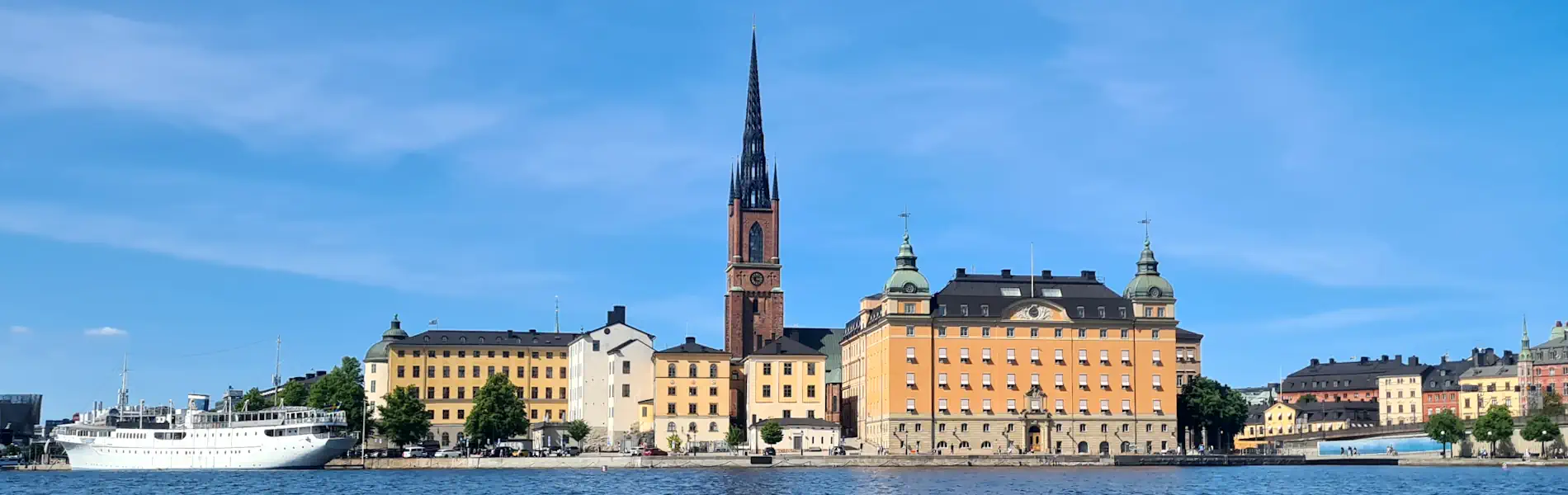
Riddarholmen Church is Sweden’s royal burial church and one of Stockholm’s most important historic monuments. Founded in the late 13th century, it houses the tombs of Swedish monarchs and represents a key example of Brick Gothic architecture.
Riddarholmen Church: Sweden’s Royal Burial Church
Rising above Riddarholmen beside Gamla Stan, Riddarholmskyrkan stands as Sweden’s dynastic mausoleum. For more than seven centuries, monarchs have been laid to rest beneath its vaulted Gothic ceilings, making it the spiritual heart of Sweden’s royal dynasty.
Founded in the late 13th century as part of a Franciscan monastery, the church is one of Stockholm’s oldest surviving buildings. Over time, it evolved from a medieval monastic sanctuary into the official royal burial church of Sweden — a role it held from the 17th century until the mid-20th century.
Riddarholmen Church forms part of a wider ecclesiastical landscape in Stockholm, alongside Storkyrkan in Gamla Stan and the German Church, and other historic churches that define Stockholm’s medieval skyline.
- Founded: Late 13th century (Franciscan monastery)
- Denomination: Lutheran (Church of Sweden)
- Style: Brick Gothic with later Baroque chapels
- Role: Royal burial church of Sweden
- Burials: Monarchs from Magnus III (d. 1290) to Gustaf V (d. 1950)
- Location: Riddarholmen island, beside Gamla Stan

From Medieval Monastery to Royal Mausoleum
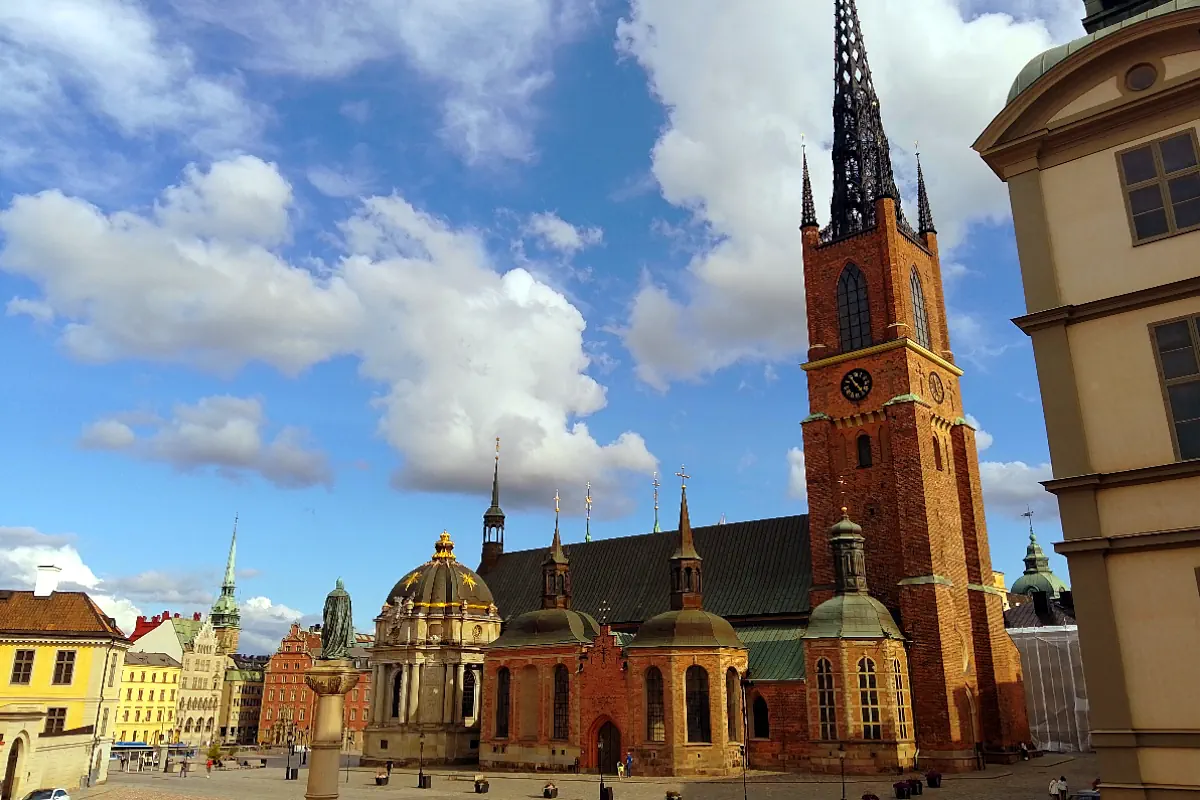
Originally constructed by the Franciscan order, Riddarholmen Church was part of a larger monastic complex that once dominated the island. Its construction took place during Stockholm’s early urban consolidation in the late 13th century. After the Protestant Reformation in the 16th century, the monastery was dissolved, and the church gradually assumed a new national role.
By the 17th century — during Sweden’s rise as a European great power — the church was formally established as the burial place of Swedish monarchs. The transformation reflected the growing need for a dynastic monument worthy of an expanding empire.
The church holds the tombs of many of Sweden’s most influential monarchs, including Gustav Vasa, Karl XI, Karl XII and later Gustavian rulers such as Gustav III and his deposed son Gustav IV Adolf, as well as Oscar II, under whom Sweden entered the modern constitutional era. The church also contains the tomb of Queen Ulrika Eleonora the Elder, whose patronage shaped the ceremonial life of the late 17th‑century court.
A Dynasty in Stone


The Chapels of Power and Memory
Inside, the church unfolds as a sequence of royal chapels added across generations. The Carolinian Chapel houses members of the House of Palatinate-Zweibrücken, while the Gustavian Chapel reflects the neoclassical tastes of the late 18th century. The Bernadotte dynasty, Sweden’s current royal house, also has burial monuments here.
Above the nave hang the coats of arms of the Order of the Seraphim — Sweden’s highest order of chivalry. When a knight of the order dies, their heraldic shield is ceremonially displayed in the church, reinforcing Riddarholmen’s continued symbolic importance.
Gothic Architecture in the Heart of Stockholm
Architecturally, Riddarholmskyrkan is Stockholm’s most prominent example of Brick Gothic. Its soaring pointed arches, ribbed vaults, and tall lancet windows reflect the medieval North German influence that shaped much of Baltic architecture.
The church’s distinctive iron spire — added in the 19th century after a lightning fire destroyed the original tower — has become one of Stockholm’s most recognizable silhouettes. Rising above Riddarfjärden, it forms part of the city’s iconic skyline alongside the Royal Palace and City Hall.
Riddarholmen in the Royal Landscape
Riddarholmen island itself forms part of Stockholm’s historic and aristocratic landscape. Nearby stand the palaces of the Swedish nobility and the House of Nobility (Riddarhuset), institutions closely linked to the monarchy and the governance of early modern Sweden.
Just across the water lies the Royal Palace in Gamla Stan — the ceremonial heart of the monarchy — while Drottningholm Palace serves as the private royal residence. Together, these three sites form a powerful royal triangle: residence, ceremony, and eternal rest.
Why Riddarholmen Church Matters
- Royal Burial Church of Sweden: The resting place of Swedish monarchs from the medieval era to the mid-20th century.
- Brick Gothic Architecture: Stockholm’s most prominent surviving example of medieval North German Gothic influence.
- Royal Orders and Heraldry: The coats of arms of the Order of the Seraphim remain displayed within the nave.
- Part of the Royal Landscape: Together with the Royal Palace and Drottningholm Palace, it completes Stockholm’s historic axis of authority, residence, and dynastic memory.
A Monument to Continuity
Riddarholmen Church is more than a historic church — it is a monument to Sweden’s dynastic continuity. Beneath its vaulted ceilings, generations of rulers rest in solemn silence, linking medieval kings to the modern constitutional monarchy.
In a city defined by water, stone, and royal heritage, Riddarholmskyrkan remains the sacred chamber of Sweden’s monarchy — where dynastic memory is preserved and Sweden’s monarchical legacy is made visible in stone.
⛪ Related Churches in Stockholm
- 👑 Storkyrkan – Stockholm’s cathedral and historic coronation church.
- 🕍 German Church – The Hanseatic merchants’ church in Gamla Stan.
- 🌿 Hedvig Eleonora Church – A Baroque landmark in Östermalm.
Explore how fortification, faith, trade, and conflict shaped the early capital.
Explore palaces, ceremonies, dynastic history, and the architecture of Swedish monarchy.




 In partnership with Agoda